
You may have seen this beautiful, and exquisite crown before worn by Her Majesty The Queen Elizabeth II, or photos and time reels of Queen Victoria. This crown was created with passion, beauty, and the desire to have a glamorous lifestyle. With looks of this fabulous crown, it also signifies its duty and service to the state provinces of England, Ireland and Scotland. However, the question remains: How did it go from a King’s head to a Queen? We’ll get into the breakdown of this spectacle of a crown and its creation, but first, we have to take a look into the eyes of its creator.
“The First Gentleman Of England”
King George IV (the oldest Uncle of Queen Victoria), became Prince Regnant in 1811 due to his father, King George III being in the state of insanity, then officially began his reign from 1820 after his father died, until 1830. During this time as King, George IV fancied the lifestyle of lavish things: fine jewelry, furniture, paintings, and of course, the State Diadem Crown. With the palace already in trouble with debt from the past interior designs and exterior expenses from the regnant at the time, King George IV had made way to wear this crown on his Coronation day.
In 1820 the King, wanted the crown a representation England, Ireland, and Scotland in preparation of his coronation in 1821. With that being said are the 3 flowers representing each country; Roses (England), Thistles (Scotland), and Shamrocks (Ireland). Along with pearls surrounding the crown, Christian cross patte’e in between the 3 flowers, 1,333 diamonds, along with a gold and silver frame. This request of such a crown was given to the Royal jewellers Rundell & Bridge, and Rundell; of the cost of 8,216 Euros, which included 800 Euros for the diamonds (keep in mind the debt it was costing the Monarchy). Since they were jewellers respectively to the crown, and the diamonds were leased, Rundell & Bridge, and Rundell decided to sell the diamonds to the royal family, keeping the diamonds on the State Diadem Crown.
From A King, To A Queen
Knowing how the King was with his flashy and proud personality, how exactly did this crown go from a King’s head to a Queen?
Once the King died in 1830, the crown was passed over to his sister-in-law, Queen Adelaide, wife of King William IV (whom is not flashy at all); taking in the theory that the King has died, with his daughter Princess Charlotte who died in 1817, his wife, Queen Caroline of Brunswick, has since passed in 1821, and his father George III, who died in a year earlier in 1820. Queen Adelaide wore this crown until the death of her husband in 1837, making the new heir, Queen Victoria the next Queen of the Monarchy to wear the Crown.
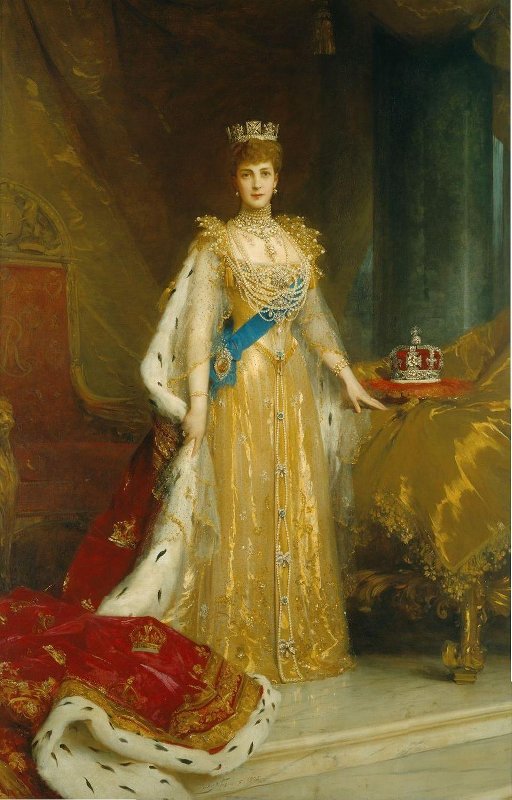
Victoria loved this crown and wore it to many events like christenings for her children, stamps and portraits. She loved it so much that she declared the crown as an Heirloom so it will pass down from Queen to Queen.
Modern Tradition
Four Queens later after Queen Adelaide: Victoria, Alexandra of Denmark, Queen Mary of Teck, and today, the current Queen Elizabeth II. She has worn this crown for her coronation in 1953, in which where the crown was first worn by King George IV, keeping the traditional style of the coronation ceremony, along with the State Opening of Parliment. This crown is also set in the Queens Gallery at Buckingham Palace when not in use for fans all over the world to view and imagine that gorgeous crown on their own heads.
Since 1952, Queen Elizabeth II has worn the State Diadem Crown all but 2 times throughout her reign The only times she has not worn the crown was in 1959 when she was pregnant with Prince Andrew, and 1963 when she was also pregnant with Prince Edward. She is the only Queen and sovereign who has worn this crown the longest in British Royal History.
Even though King George IV was smitten, he took to lengths to remove the Imperial State Crown with the State Diadem Crown. Parliament wasted no time in saying no since it was a part of the history of the monarchy (Crown and Parliament Recognition Act of 1689), also meant to be worn at the closing of coronations, and State Openings of Parliament.
I find the State Diadem Crown to be a beauty in its own right with meaning and a proud representation of England, Ireland, and Scotland. King George IV may have been a little flamboyant, but he remembered how much this crown meant to not only himself, but to the Monarchy.
References